


What is a Briss?
 Briss — Berith: the Jewish rite of circumcision performed on a male child on the eighth day of his life.
The Milah is one of the two symbols of the covenant; Shabbat being the other (Genesis 17 v11-12). It is one of the first rites attacked in times of persecution and its neglect in history was a sign of the abandonment of the faith.
The Ceremony
Brith Milah or Bris Milah is covenant of circumcision – often just referred to as Bris.
Some families will invite the neighboring children round the night before to see the baby, say the “Shema” and sing some songs. Sweets are given out. (This is a joyous event and food plays its part)
There must be a minyan (ten adult men) present. The circumcision is performed by a mohel (pronounced moyle), who will very likely be both a doctor and a rabbi.
The boy is welcomed, “Baruch haba” – blessed is he who comes. (See Psalm 118) Elijah the Prophet is included in this welcome as rabbinical tradition holds that the prophet participates in every milah as witness and protector.
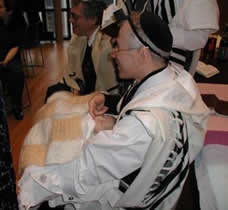
The Sandek (Godfather) hands the baby to the mohel, who may put the boy on “the chair of Elijah” before handing him back to the sendek who then holds him firmly. The mohel, the boy’s father and those present join in blessings and prayers while the circumcision is carried out. The prayers ask that all will go well, acknowledging how much we all need God’s help. After dressing the wound, the mohel says the blessing for wine and gives the boy a drop or two with his finger. Remember the symbolic use of wine to represent blood and blood covenants. The mohel stresses the sanctity of this covenant before saying the final prayer, during which the lad is given his Hebrew name. ” . . . . Just as this little one has entered the covenant, so too may he grow up to attain the Torah, marriage and good deeds.” This Hebrew name is more than just a label – it is an adjective – it says something about the boy – like the names in he Tanakh.
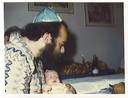 Brit milah (Hebrew: bÉ™’rÄ«t mÄ«’lÄ literally: “covenant [of] circumcision”), also berit milah (Sephardi), bris milah (Ashkenazi pronunciation) or bris (Yiddish) is a religious ceremony within Judaism to welcome infant Jewish boys into a covenant between God and the Children of Israel through ritual circumcision performed by a mohel (“circumciser”), on the eighth day after birth unless health reasons force a delay, in the presence of family and friends, followed by a celebratory meal (seudat mitzvah). The ritual had virtually been unchallenged within the religion until the nineteenth century advent of Reform Judaism.
According to the Hebrew Bible, in the Book of Genesis 17:1-14, circumcision was enjoined when God said “Walk before Me and be perfect” to the Biblical patriarch Abraham to be followed by his descendants as “a token of the covenant” concluded with him by God for all generations. It is also when his name is changed from “Abram” to “Abraham” by God:
‘Abram was 99 years old. God appeared to him and said, ‘I am God Almighty. Walk before Me and be perfect. I will make a covenant between Me and you, and I will increase your numbers very much.’ Abram fell on his face. God spoke to him [again], saying, ‘As far as I am concerned, here is My covenant with you: You shall be the father of a horde of nations. No longer shall you be called Abram.
 Your name shall become Abraham, for I have set you up as the father of a horde of nations. I will increase your numbers very, very much, and I will make you into nations — kings will be your descendants. I will sustain My covenant between Me and between you and your descendants after you throughout their generations, an eternal covenant; I will be a God to you and to your offspring after you.
To you and your offspring I will give the land where you are now living as a foreigner. The whole land of Canaan shall be [your] eternal heritage, and I will be a God to [your descendants].’ God [then] said to Abraham, ‘As far as you are concerned, you must keep My covenant — you and your offspring throughout their generations. This is My covenant between Me, and between you and your offspring that you must keep: You must circumcise every male. You shall be circumcised through the flesh of your foreskin.
This shall be the mark of the covenant between Me and you. ‘Throughout all generations, every male shall be circumcised when he is eight days old. [This shall include] those born in your house, as well as [slaves] bought with cash from an outsider, who is not your descendant. [All slaves,] both houseborn and purchased with your money must be circumcised. This shall be My covenant in your flesh, an eternal covenant. The uncircumcised male whose foreskin has not been circumcised, shall have his soul cut off from his people; he has broken My covenant.’ Genesis 17:1-14.
The penalty of non-observance is karet, “excision” from the people or being cut off from the community by God, as noted in Genesis 17:14. Conversion to Judaism for non-Israelites in Biblical times necessitated circumcision otherwise one could not partake in the Passover offering (Exodus 12:48). Today, as in the time of Abraham, it is required of converts in Orthodox and Conservative Judaism. (Genesis 34:14-16).
As stated in the above : “God [then] said to Abraham, ‘As far as you are concerned, you must keep My covenant – you and your offspring throughout their generations. This is My covenant between Me, and between you and your offspring that you must keep: You must circumcise every male. You shall be circumcised through the flesh of your foreskin. This shall be the mark of the covenant between Me and you. ‘Throughout all generations, every male shall be circumcised when he is eight days old. [This shall include] those born in your house, as well as [slaves] bought with cash from an outsider, who is not your descendant. [All slaves,] both houseborn and purchased with your money must be circumcised. This shall be My covenant in your flesh, an eternal covenant. The uncircumcised male whose foreskin has not been circumcised, shall have his soul cut off from his people; he has broken My covenant.”
Brit milah is considered to be so important that should the eighth day fall on the Sabbath, actions that would normally be forbidden because of the sanctity of the day are permitted in order to fulfill the requirement to circumcise.


Why the 8th Day?
Great blog!!! Very informative and inciteful. Excellent!!!
Comfortabl y, the article is actually the freshest on this worthw hile topic. I concur with your conclusions and will thirstily look forward to your upcoming updates. Just saying thanks will not just be adequate, for the exceptional clarity in your writing. I will at once grab your rss feed to stay informed of any updates. De lightful work and much success in your business enterprise!
Advantageously, the article is really the freshest on this deserving topic. I concur with your conclusions and will eagerly look forward to your incoming updates. Saying thanks will not just be adequate, for the extraordinary lucidity in your writing. I will directly grab your rss feed to stay informed of any updates. Solid work and much success in your business efforts!
I would give your site a boost and grab the free seo guide from 999seo.com
Just come accross your blog on digg, whats your favorite social bookmark site?
Hello. This is kind of an “unconventional” question , but have other visitors asked you how get the menu bar to look like you’ve got it? I also have a blog and am really looking to alter around the theme, however am scared to death to mess with it for fear of the search engines punishing me. I am very new to all of this …so i am just not positive exactly how to try to to it all yet. I’ll just keep working on it one day at a time Thanks for any help you can offer here.
Please help people in haiti and google donate to haiti children.
Just want to say your article is striking. The clarity in your post is simply striking and i can take for granted you are an expert on this subject. Well with your permission allow me to grab your rss feed to keep up to date with forthcoming post. Thanks a million and please keep up the ac complished work. Excuse my poor English. English is not my mother tongue.
One can imagine I read it twice. While I am not as skilled on this topic, I tally with your conclusions because they create sense. Thanks and goodluck to you.
This is one amongst the most effective blog posts that I’ve probably ever read. It’s sort of a well-written paper. Your topic is relevant, you’ve broken the topics down logically.
Nice post! These are important things to stay in mind, it’s usually simple to forget concerning the straightforward things after you get consumed by a project.
Dominatrix are so amazing , you need to post more about this topic
Hi, I value your blog! Found it on Bing when I was looking for wedding dress taeyang.
isn’t it the happiest moment in our lives when we see the woman we love in a Pure white wedding dress?.”*~
are there any other good internet links about Reiki? i am really interested about it.~-*
my father practices Reiki and it is helpful for the general health.”.:
wedding day is always the most special day of any man and woman`*’
reiki is an interesting discipline that i would like to learn,`;